

Table of Contents
- What You'll Need Before You Start
- Step 1: Understand Full-Grain Leather Durability
- Step 2: How to Identify Quality Leather
- Step 3: Choose the Right Hardware for a Durable Leather Keyring
- Step 4: Weigh Up Weight and Bulk for Everyday Carry
- Step 5: Compare Leather Keyring Options
- Leather Keyring Care Guide for Long-Term Use
- Common Mistakes to Avoid When Buying a Leather Keyring
- Frequently Asked Questions
Last Updated: September 24, 2026
What You'll Need Before You Start
Choosing a durable leather keyring for daily use comes down to three things: the leather, the hardware, and how you actually carry your keys. Get those right and you'll have a keyring that outlasts your car.
This guide from CraftyDrifters Cornwall walks you through each step. We make small-batch leather goods.
Here's what to have in mind before you shop:
- Your daily key count (three keys or twelve changes everything)
- Whether you carry keys in a pocket, bag, or on a belt
- Your budget and how long you expect the keyring to last
- A rough idea of the leather type you want
Most cheap keyrings fail at the hardware, not the leather. That's the bit almost every buying guide skips.
Step 1: Understand Full-Grain Leather Durability
Full-grain leather is the top layer of the hide, kept intact with all its natural fibres. That fibre structure is what gives it tensile strength and abrasion resistance. Nothing else in the leather world matches it for longevity.
Lower grades get sanded down to hide flaws. That removes the strongest part of the hide. Full-grain keeps it.
The trade-off? Full-grain shows marks. It scuffs, darkens, and changes. Many people call that a flaw. We call it patina.
Full-Grain vs Top-Grain: What the Labels Don't Tell You
Top-grain leather has its surface sanded and sometimes coated. It looks uniform out of the box. It also wears faster where it bends and rubs.
Full-grain costs more because less of the hide is wasted. For a keyring that lives in your pocket every day, that extra cost buys you years.
Check the label carefully. "Genuine leather" means almost nothing. It can describe bonded scraps held together with glue.
Step 2: How to Identify Quality Leather
Good leather feels firm but flexible. Press your thumb into it. It should spring back slowly, not feel spongy or plastic.
Here's what to check before you buy:
- Hide quality: Look for visible grain and slight variation in tone
- Tanning process: Vegetable-tanned leather ages better than most chrome-tanned
- Smell: Real leather smells earthy, not chemical
- Edges: Cleanly finished edges resist fraying
Vegetable-tanned leather takes longer to produce. It also develops a richer patina over time.
Checking Stitch Integrity and Material Thickness
Run your finger along the stitching. Even, tight stitches mean the maker cared. Loose or uneven stitches will pull apart under daily wear and tear.
Material thickness matters too. A keyring needs enough body to hold its shape. Too thin and it stretches. Too thick and it feels clumsy in a pocket.
If two threads cross at each hole, that's a good sign.
Step 3: Choose the Right Hardware for a Durable Leather Keyring
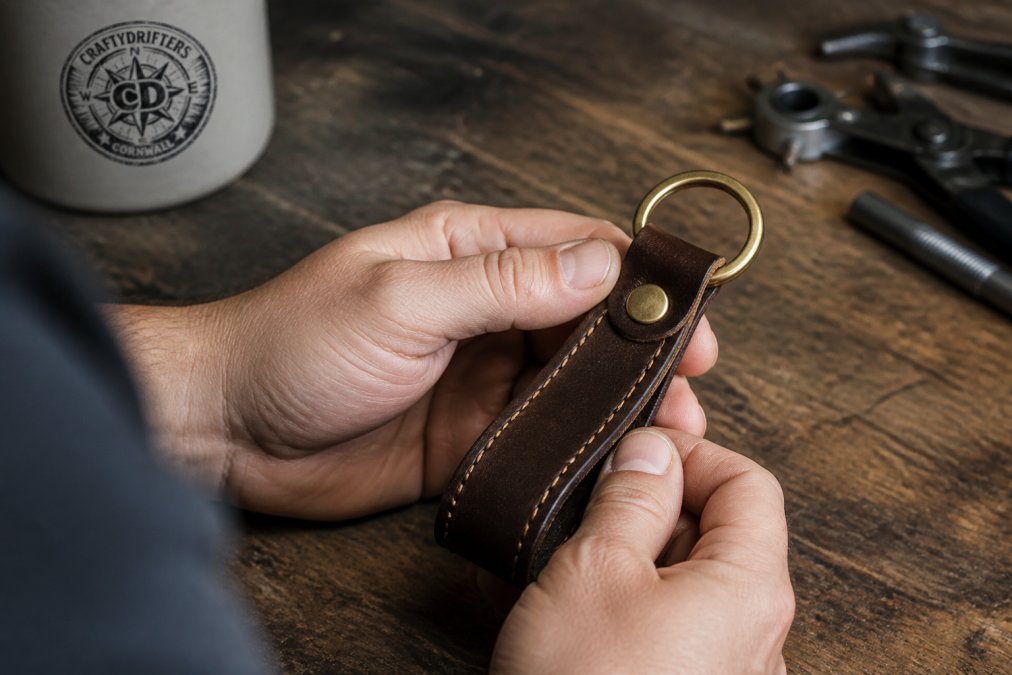
Hardware is where most keyrings die. A split ring is a coiled metal loop that holds keys directly. A clasp mechanism opens and closes, often with a small lever or screw gate. Both work. They fail in different ways, and almost no buying guide tells you which way.
The Three Hardware Failure Modes Nobody Warns You About
1. Plating flaking and galvanic corrosion. Cheap hardware is often zinc-plated or nickel-plated steel. Once the plating chips, usually within months against keys, the exposed base metal corrodes fast. Sweat accelerates this. A keyring that lives in a pocket is constantly exposed to moisture and salts, so plated hardware is a false economy.
2. Split ring fatigue and gaping. A split ring relies on spring tension. Repeated prying to add or remove keys widens the coil. Once the gap opens, keys slip off silently. Thicker wire resists this better than thin wire, but too thick and you cannot open it without tools. Solid brass and stainless steel hold tension far longer than mild steel.
3. Clasp lever creep. Lever clasps and screw gates have a moving part. Over thousands of open-close cycles, the lever loosens or the screw thread wears. A screw gate that is not fully tightened can work itself open against pocket fabric. Lever clasps are faster but more prone to creep; screw gates are slower but more secure when properly seated.
Matching Hardware to Carry Style
| Hardware | Failure Mode | Best For | Watch Out For |
|---|---|---|---|
| Solid brass split ring | Coil gaping | Heavy daily key loads | Weight; needs occasional squeeze to close gap |
| Stainless steel split ring | Coil gaping (slower) | Wet or sweaty environments | Stiffer to open; can scratch keys |
| Lever clasp | Lever creep | Clip-on/clip-off bag use | Check lever tension monthly |
| Screw gate | Thread wear | Secure attachment | Must be fully tightened; slower to use |
| Plated alloy | Plating flake, corrosion | Light, occasional use only | Avoid for daily pocket carry |
For heavy-duty daily use, a solid brass or stainless steel split ring is the safer bet. For a key strap you clip on and off a bag, a well-made clasp makes sense, but treat the clasp as a wear item and inspect it.
The Attachment Point Matters as Much as the Ring
Where the hardware meets the leather is a stress concentration. A rivet through a single layer of leather will pull through long before the leather itself wears out. Better construction uses a folded and stitched loop, or a rivet backed by a washer or second layer. Look for stitching around the hardware attachment, not just a single rivet.
Ask the maker what the hardware is made of, not just what it looks like. "Solid brass" and "brass-plated" are very different answers. If they cannot tell you, that tells you something too.
Step 4: Weigh Up Weight and Bulk for Everyday Carry
Weight and bulk decide whether you actually enjoy carrying a keyring. A heavy brass setup with twelve keys becomes a lump in your pocket. That is how keyrings end up abandoned in a drawer. But the mechanics matter more than the vague advice most guides offer.
How Thickness and Key Count Interact
A leather keyring's bulk comes from three things: leather thickness, hardware gauge, and key count. They compound.
- Leather thickness: 2-3 mm is the sweet spot for a keyring. Under 2 mm and the leather stretches around the hardware; over 4 mm and it feels like a doorstop in a front pocket.
- Hardware gauge: A solid brass split ring in a heavier gauge adds noticeable weight. Stainless steel is denser still. If weight matters, a thinner-gauge stainless ring is a reasonable compromise.
- Key count: Three to five keys is the practical daily limit for pocket carry. Beyond that, the bunch fans out, digs into your leg when you sit, and abrades the leather faster because the keys move independently.
Pocket Geometry: Why Front Pocket Carry Changes Everything
A front pocket is a curved, moving space. When you sit, the pocket compresses. A bulky keyring presses against the thigh; a slim one disappears. The leather also rubs against the pocket lining and the keys rub against the leather. More bulk means more surface area in contact, which means faster wear on both the leather and your trousers.
Key organization is the fix. A few keys on one ring beat a jangling bunch every time. If you carry more than five keys daily, split them: daily set on the leather keyring, occasional keys on a separate ring in your bag.
Attachment Geometry: Belt, Bag, or Pocket
- Front pocket: Keep it slim and light. A flat keyring with a single split ring and three to four keys is ideal. Avoid clasps that add a lump.
- Bag or backpack: Weight matters less, but a clasp is more convenient because you can detach the keys without emptying the bag.
- Belt clip: Check the attachment point holds firm. A belt clip concentrates load on one point of the leather, so the leather there needs to be thick enough and reinforced. A clip that rotates freely reduces twisting stress on the leather.
The Accessibility Trade-Off
Slimmer keyrings are more comfortable but can be harder to grab. A keyring with a small leather tab or fob gives you something to pinch without pawing at keys. That tab also protects the leather from direct key abrasion at the attachment point.
Minimalist design is not just about looks. Less bulk means less pocket friction, which means less wear on the leather and your clothes. The goal is the smallest keyring that still holds your daily keys securely and lets you find them without a struggle.
Step 5: Compare Leather Keyring Options
Different leathers suit different people. Here's how the main options stack up for everyday carry.
| Leather Type | Durability | Patina | Best For |
|---|---|---|---|
| Full-grain | Highest | Develops richly | Daily use, long-term |
| Top-grain | Good | Minimal | Uniform look, lower cost |
| Vegetable-tanned | High | Develops strongly | Those who want character |
| Chrome-tanned | Moderate | Slow | Colour consistency |
Full-grain wins on material resilience. It takes knocks, holds shape, and looks better as it ages.
If you want a matching piece for your pocket, our full-grain leather card holder is built from the same heavyweight leather. The Rustic5 holds 8 to 10 cards and carries a lifetime warranty against manufacturing defects.

That's the standard to hold any leather keyring to. If the maker won't stand behind it, walk away.
Leather Keyring Care Guide for Long-Term Use
A leather keyring care guide is short, because good leather needs very little. Keep it dry, condition it occasionally, and let it age.
- Wipe with a dry cloth if it gets wet
- Condition every few months with a quality leather balm
- Keep it away from prolonged heat
- Let any marks settle rather than scrubbing them out
Avoid soaking leather or drying it with heat. Both strip the natural oils that keep it supple.
Vegetable-tanned leather darkens with sunlight and handling. That's the patina developing, and it's the whole point of buying real leather.
Common Mistakes to Avoid When Buying a Leather Keyring
The biggest mistake is buying on looks alone. A keyring can look lovely and still fall apart in six months. Check the hardware durability first.
Other traps to dodge:
- Trusting "genuine leather" as a quality label
- Ignoring material thickness
- Overloading a slim keyring with too many keys
- Skipping care entirely, then blaming the leather
- Buying plated hardware that corrodes
A common mistake is assuming a higher price guarantees better leather. It doesn't. Check the grain, the stitching, and the metal.
Frequently Asked Questions
What is the most durable type of leather for keyrings?
Full-grain leather is the most durable choice for a keyring. It keeps the hide's natural surface intact, so it resists abrasion and develops a patina rather than cracking. Vegetable-tanned full-grain is especially hard-wearing because the tanning process preserves the fibre structure. Avoid bonded or corrected-grain leather, which can peel or split within months of daily pocket friction.
How can you tell if a leather keyring is high quality?
Look at the grain, the stitching, and the hardware. Quality full-grain leather has an uneven, natural surface rather than a uniform plastic sheen. Stitches should be tight, even, and sunk slightly into the leather. Hardware should feel heavy and be rust-resistant, ideally solid brass or stainless steel. A maker who lists the tannery or leather type is usually a good sign.
Do leather keyrings hold up well to daily wear and tear?
Yes, if you choose full-grain leather with solid hardware. The leather itself often outlasts the metal. The weak points are usually the split ring losing tension or the clasp mechanism failing, not the leather tearing. Wipe it occasionally, keep it dry, and condition it once or twice a year to maintain suppleness and prevent cracking.
How should you care for a leather keyring to ensure longevity?
Keep it away from prolonged moisture and direct heat. Wipe with a dry cloth if it gets wet, then let it air dry naturally. Apply a small amount of quality leather conditioner every six to twelve months to keep the fibres supple. Avoid over-oiling, which can darken the leather unevenly and attract dirt. Store it in a dry place when not in use.
Picking a keyring that lasts means looking past the finish and checking the parts that fail: the leather grade, the stitching, and the metal. That's exactly how we build every piece at CraftyDrifters Cornwall, using full-grain leather that ages beautifully and hardware chosen to survive daily use. Every keyring is handcrafted in small batches, so no two are quite the same. Get started with CraftyDrifters Cornwall and carry something built to last for years, not months.
0 comments